Curved structures are increasingly common in exhibits, experiential environments, retail spaces, branded interiors, and architectural displays.
They can create movement, soften transitions, frame focal points, and introduce forms that feel more dynamic than conventional straight framing. One of the manufacturing processes that makes many of those structures possible is extrusion bending.
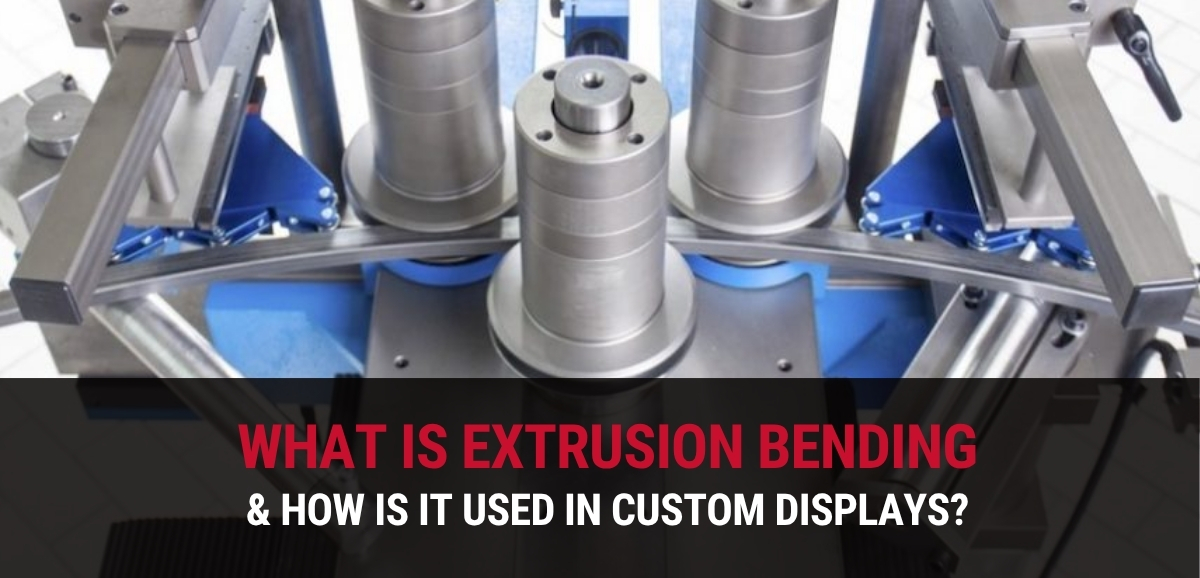
Extrusion bending allows straight aluminum profiles to be formed into controlled curves while preserving the functional features built into the extrusion itself.
That can make it possible to create curved walls, arches, headers, light boxes, perimeter frames, portals, and other custom display components without abandoning the structural advantages of aluminum extrusion.
But extrusion bending is only one fabrication method.
The best structural approach still depends on the design, radius, application, graphic system, engineering requirements, shipping plan, installation method, and intended reuse. That is why extrusion bending is most useful when it is considered as part of a broader fabrication strategy.
For a wider look at the different structural systems used to create curved displays, explore Curved Structure Systems and Fabrication Methods.
What Is Aluminum Extrusion?
Before looking at the bending process, it helps to understand what extrusion is.
Aluminum extrusion is a manufacturing process used to create aluminum profiles with a consistent cross section. Those profiles can be designed with channels, grooves, connection points, cavities, and other features that support specific functions.
In custom displays and branded environments, extrusion is commonly used for:
- Graphic frames
- Exhibit walls
- Light boxes
- Headers
- Architectural features
- Modular structures
- Perimeter framing
- Retail displays
- Custom enclosures
Because the profile remains consistent along its length, extrusion can provide predictable connection points and interfaces for graphics, lighting, hardware, panels, and other components.
That makes it especially useful in systems that need to be assembled accurately and repeatedly.
What Is Extrusion Bending?
Extrusion bending is the process of forming a straight aluminum extrusion into a controlled radius or curve. The goal is not simply to bend the metal.
The process must create the intended geometry while preserving the profile closely enough for it to continue functioning as designed.
That distinction is important.
Many extrusions include structural or functional details that need to remain usable after bending. A profile may need to accept a fabric graphic, connect to another frame member, support lighting components, or align with hardware.
If the profile distorts too much during bending, those features may no longer work correctly. Successful extrusion bending therefore depends on the relationship between the material, profile geometry, bend radius, tooling, and intended application.
Why Bend Extrusion Instead of Building the Curve Another Way?
There are several ways to create a curved structure. A curved display could be built using bent tubing, formed SnapTube, fabricated aluminum, segmented framing, or a combination of systems.
Extrusion bending becomes especially useful when the design benefits from the functional features already built into an extruded profile.
For example, a curved frame may need to:
- Accept a tension fabric graphic
- Integrate lighting
- Connect to straight extrusion
- Support modular hardware
- Maintain a specific channel configuration
- Provide a clean finished perimeter
In those situations, bending the extrusion can preserve the advantages of the framing system while extending it into curved geometry. The result is not simply a curved piece of aluminum. It is a curved structural component that still needs to perform as part of a larger system.
Common Uses for Extrusion Bending in Custom Displays
Extrusion bending can support a wide range of custom display applications.
Curved Walls
Curved walls can help guide movement through a space, create softer transitions, and introduce more visual variety than conventional straight walls.
Bent extrusion may be used to create the perimeter or structural framework for tension fabric graphics, printed surfaces, decorative finishes, or integrated lighting.
The exact radius and framing method depend on the dimensions, materials, and intended use of the wall.
Arches and Portals
Arches can define entrances, frame products, connect zones within an exhibit, or create a stronger architectural presence.
Curved extrusion can be useful when the arch also needs to support graphics, lighting, or modular connections.
Depending on the span and load, the curved extrusion may be combined with additional framing or fabricated reinforcement.

Curved Headers
Headers are often used to introduce branding above an exhibit or create a visual connection between different areas.
Curved extrusion can make it possible to create sweeping headers, partial circles, and other radius based forms while retaining familiar connection methods. Weight, span, stiffness, and installation all influence how the finished structure is engineered.
Curved Light Boxes
Light boxes are one of the more demanding applications for extrusion bending because the structure has to support both the graphic and the lighting system.
The bend must work with:
- Graphic fit
- Light distribution
- Frame depth
- Electrical components
- Connection points
- Service access
- Adjacent straight or curved sections
A curved light box may look visually simple once installed, but several systems need to work together behind the finished graphic.
Perimeter Frames
Bent extrusion can also be used to create curved edges or perimeter elements within a larger structure. This can help designers introduce curved geometry without making the entire display curved.
A single radius feature may be enough to soften a transition, frame a focal point, or visually distinguish one area from another.
Custom Dimensional Forms
Some designs do not fit neatly into standard categories. Curved extrusion may be combined with straight framing, tubing, fabricated components, graphics, and lighting to create more complex dimensional forms.
In these applications, extrusion bending becomes one part of a larger custom fabrication solution.
Not Every Extrusion Bends the Same Way
One of the most important things to understand about extrusion bending is that every profile behaves differently. The cross section of the extrusion influences how easily it can be formed.
Factors include:
- Profile width
- Profile depth
- Wall thickness
- Internal channels
- Open sections
- Hollow sections
- Material properties
- Bend direction
- Required radius
Some profiles tolerate tighter radiuses than others. Some may need a larger bend radius to avoid distortion. Others may require specific tooling or process adjustments.
That is why the feasibility of a curved extrusion should be evaluated before the geometry is finalized.
Bend Radius Matters
The bend radius is one of the first technical considerations in any curved extrusion application. A large sweeping radius is generally easier to achieve than a very tight curve. As the radius becomes smaller, the material experiences more deformation.
That can lead to:
- Flattening
- Twisting
- Wall distortion
- Channel deformation
- Surface changes
- Dimensional variation
The acceptable amount of change depends on how the profile will be used.
A decorative component may tolerate more variation than an extrusion that needs to accept a precise connector or graphic system. Early engineering review helps determine whether the desired radius is practical for the selected profile.
Maintaining Profile Geometry
Extruded profiles are often useful because of the details built into them.
A groove may hold fabric. A cavity may accept a connector. A channel may support lighting. A slot may align with modular hardware. Those features need to remain usable after bending. That means the quality of the bend is not judged only by whether the outside shape looks correct.
The profile also needs to maintain enough dimensional accuracy for the rest of the system to function. This is one reason extrusion bending benefits from close coordination between engineering and manufacturing.
How Extrusion Bending Works With Tension Fabric
Tension fabric is frequently paired with aluminum extrusion. Many fabric systems rely on channels in the extrusion to secure and tension the graphic.
When the extrusion is curved, the fabric needs to follow that same geometry accurately. That creates several related considerations.
The frame geometry affects the fabric pattern. The fabric pattern affects seam placement. The radius affects tension. The tension affects the finished appearance.
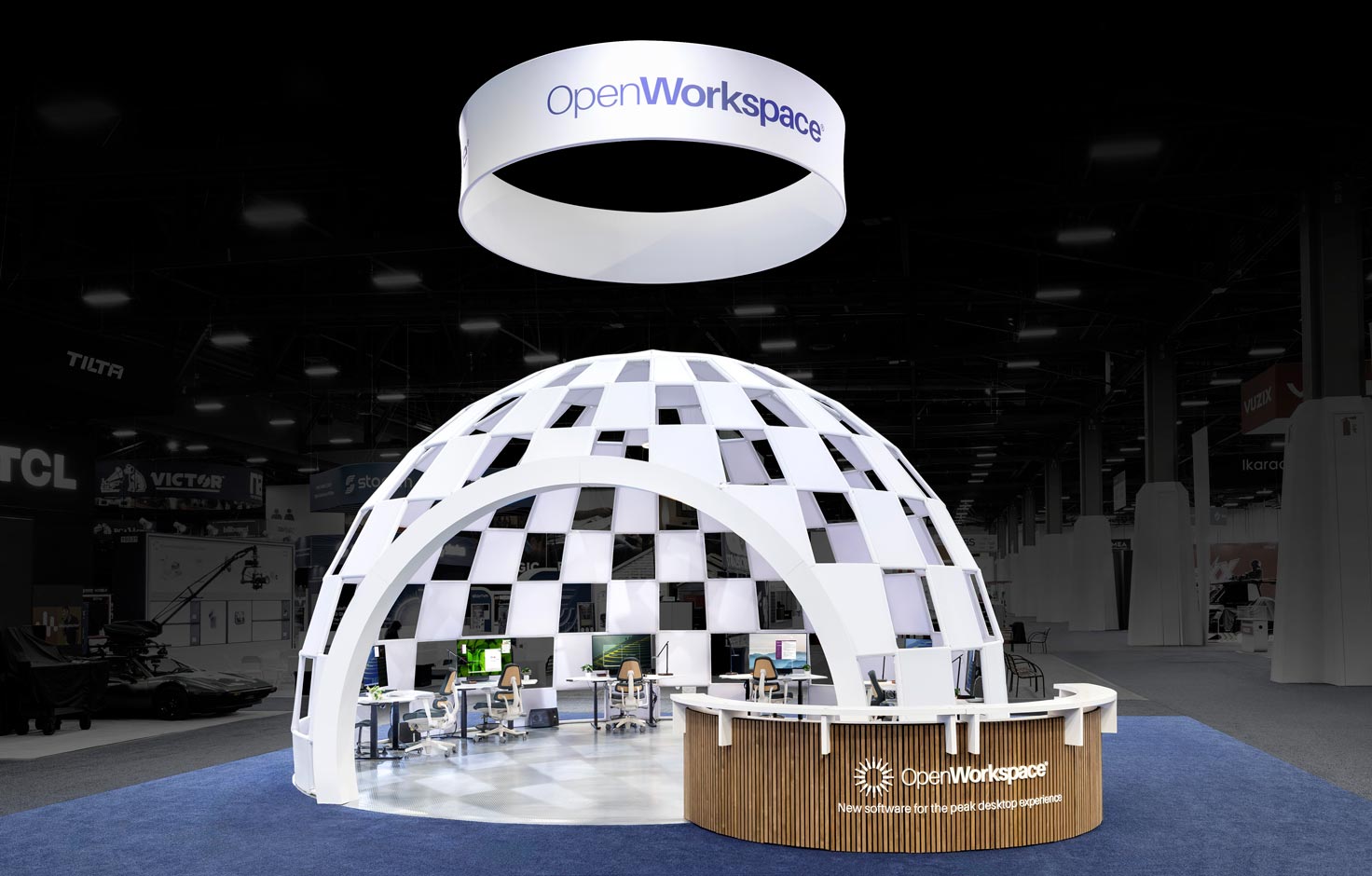
For curved displays, the structure and the textile graphic should therefore be developed as parts of the same system.
This becomes even more important when the finished design includes large continuous graphics or compound forms.
Extrusion Bending and Lighting
Lighting can add another layer of complexity to curved extrusion systems. A curved light box, for example, needs to maintain even illumination across the radius.
The frame depth, LED spacing, graphic material, internal reflections, and distance between the light source and the graphic surface all affect the final result.
The structure also needs to accommodate wiring, drivers, connections, and service access. This is why lighting should be considered early rather than added after the frame has already been engineered.
Straight and Curved Extrusion Often Work Together
Many custom structures combine straight and curved sections. A wall may begin straight and transition into a curve. An arch may connect to vertical straight members. A light box may include curved corners with straight runs between them.
These transitions need to be engineered carefully.
The curved component needs to align with the straight extrusion in a way that preserves the intended geometry and allows the connection to function properly.
Connection points may require:
- Machining
- Custom brackets
- Fabricated plates
- Internal connectors
- Reinforcement
- Alignment hardware
In many projects, the transition between structural systems is just as important as the bend itself.
Extrusion Bending Versus Tube Bending
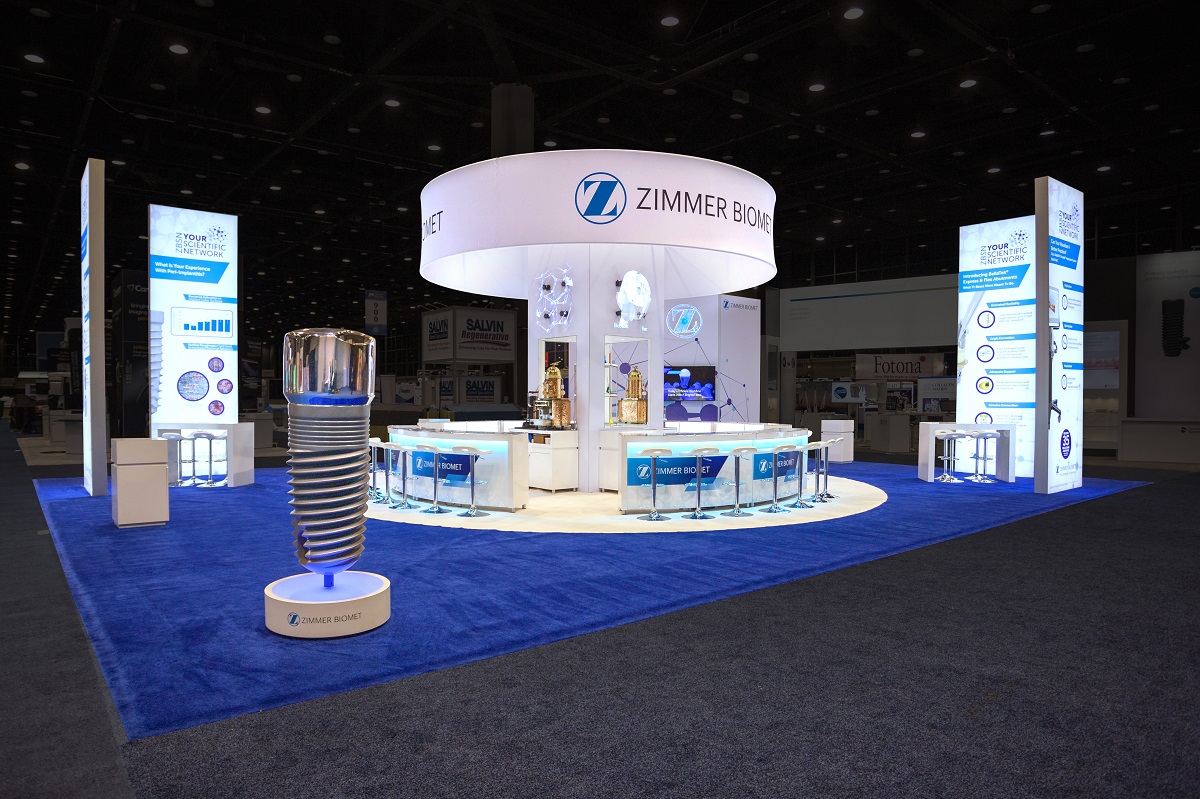
Extrusion bending and tube bending are related processes, but they serve different purposes. Tube bending is often useful for dimensional structural frameworks, sculptural forms, open structures, domes, arches, and custom support systems.
Extrusion bending is often selected when the profile itself includes functional features needed for graphics, hardware, lighting, or modular assembly.
Neither process is inherently better. The right choice depends on what the structure needs to accomplish. A custom display may even use both. For example, bent tubing might provide the internal support structure while curved extrusion creates a finished graphic perimeter.
Extrusion Bending Versus Segmented Construction
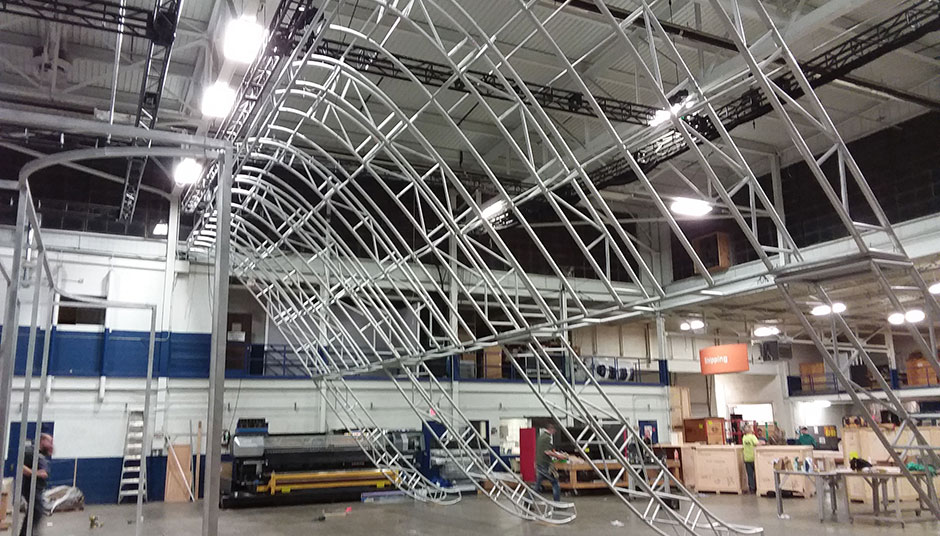
Not every curved appearance needs to be created from a continuously bent profile. Some large radius structures can be built using segmented straight sections.
That may be practical when:
- The curve is very large
- Freight dimensions are restrictive
- Modularity is important
- The finished surface hides the structural segmentation
- The geometry is intentionally faceted
The decision between continuous bending and segmented construction depends on the visual requirements and the practical demands of the project.
The best solution is the one that achieves the desired result while remaining efficient to manufacture, ship, install, and reuse.
Shipping Curved Extrusion
Curved components can create shipping challenges because they do not always pack as efficiently as straight members.
A large radius may occupy significant crate space even if the extrusion itself is lightweight.
That means the engineering process should consider:
- Maximum section size
- Crate dimensions
- Truck capacity
- Nesting possibilities
- Protective packaging
- Connection locations
- Field assembly
In some cases, a large curve may be divided into smaller sections so it can be transported more efficiently.
Those sections must then reconnect accurately enough for the curve to appear continuous once installed.
Designing for Installation
A curved extrusion system also needs to work in the field. Installers need to understand how the components connect, align, and support adjacent graphics or finishes.
Factors may include:
- Component weight
- Section length
- Alignment points
- Connection access
- Installation sequence
- Graphic attachment
- Lighting integration
- Adjustment in the field
The more accurately these considerations are addressed during engineering and fabrication, the smoother installation can be.
Designing for Reuse
Many custom displays are intended for repeated use. That means curved components may need to be installed, dismantled, packed, shipped, and reassembled multiple times.
Connections need to be durable and repeatable. Graphics may need to be replaceable. Finished surfaces need to withstand handling. Components should also be organized and packed in a way that makes future installations manageable.
A curved structure should therefore be evaluated over its entire life cycle, not just its first installation.
Why In House Extrusion Bending Matters
The biggest advantage of bringing extrusion bending in house is not simply access to another piece of equipment. It is greater coordination between the bend and everything that happens around it.
The extrusion can be evaluated alongside:
- Engineering
- Tube processing
- Aluminum fabrication
- Machining
- Welding
- Printing
- Sewing
- Lighting
- Finishing
- Trial assembly
- Packing
- Installation support
That can make it easier to resolve fit, connection, graphic, and structural questions within one manufacturing process. The machine supports the capability.
The broader value comes from integrating extrusion bending into a complete fabrication system.
Early Collaboration Creates More Options
Extrusion bending is most effective when it is considered early in the design process. A creative concept may call for a radius that is difficult for a particular profile. A small change to the geometry may make the structure much easier to manufacture without changing the visual intent.
A different extrusion may provide a better connection method. A curved component may need to be divided differently for shipping. Those decisions are easier to make before engineering is finalized.
Early collaboration between designers, engineers, and manufacturers creates more flexibility and reduces the risk of discovering fabrication limitations late in the process.
Extrusion Bending Is a Design Tool
Extrusion bending expands what aluminum framing systems can do.
It can support curved walls, arches, headers, light boxes, portals, and custom dimensional structures while maintaining many of the functional advantages that make extrusion useful in the first place.
But the bend itself is only part of the solution. The strongest custom display systems consider structure, graphics, lighting, shipping, installation, and reuse together. That is the larger value of extrusion bending. It gives designers another way to turn curved concepts into practical, manufacturable structures.
Planning a Curved Display?
If your next project includes curved framing, arches, headers, light boxes, walls, or custom dimensional forms, early manufacturing input can help determine whether extrusion bending is the right structural approach.
Tectonics combines extrusion bending with engineering, tube processing, aluminum fabrication, SnapTube, printing, sewing, finishing, and installation support to help turn curved design concepts into complete display systems.
Talk with Tectonics about the structural options for your next curved project.